
Functional Genomics
Your DNA Holds Answers
For years, many of us cycle through the same frustrating pattern: symptoms appear, we treat them, they return, we treat them again. Headaches become a daily companion managed with painkillers. Brain fog is blamed on stress or aging. Joint pain, digestive issues, chronic fatigue—each gets its own band-aid while the root cause remains hidden beneath the surface.
We're told these are just part of getting older, or that we need to manage stress better, or perhaps try yet another elimination diet. But what if these seemingly unrelated symptoms all pointed back to something more fundamental—to the unique way your body processes nutrients, handles toxins, and responds to environmental exposures based on your genetic blueprint?
This is where functional genomics transforms everything, shifting us from endlessly managing symptoms to finally understanding their root causes.

Understanding Your Genetic Terrain
Your DNA is your body's instruction manual—revealing which systems run smoothly and which operate with dimmer switches that make you vulnerable to specific stressors. Think of your genetic code as the soil composition of a garden: some areas are naturally rich and fertile, others are sandy or depleted, requiring different care to flourish.
These genetic variations are called single nucleotide polymorphisms (SNPs)—small differences in your DNA that determine how your genes function. Specifically, they influence how your body processes (or doesn't process) what you ingest and what you're exposed to.
Understanding your SNPs empowers you to work with your body's actual design rather than against it, enabling truly personalized choices that support your weakest systems. This isn't about achieving perfection; it's about learning to nourish and protect the particular terrain you're cultivating.
The Dimmer Switch Effect
Most genetic variations don't completely shut down a function—they dim it. Like a light on a dimmer switch, these SNPs don't shatter a process entirely but dial down efficiency just enough to tip the scales toward trouble over time, especially under stress.
The spectrum looks like this:
Rare genetic diseases present when SNP combinations severely hinder critical functions. Sickle Cell Anemia, for instance, causes problems in red blood cells' hemoglobin production (affecting 1 in 365 African Americans). Dravet Syndrome, where a key brain protein isn't made, affects 1 in 15,700 births.
Common conditions affect broad populations through clusters of dimmer SNPs. Heart disease, diabetes, arthritis, and cancer all involve known SNPs that contribute to inflammation, brain fog, and metabolic imbalances. Most of us carry several of these dimmer switches.
Example: Type 2 Diabetes Risk A pancreatic SNP that slows glucose metabolism (rs7903146 in the TCF7L2 gene):
Strong dimmer version: increases risk by 50% (present in ~10% of European descendants)
Partial dimmer version: increases risk by 30% (present in ~40% of European descendants)
If someone with these variations eats a carb-heavy processed diet and lives an inactive lifestyle, their pancreatic system comes under pressure that can manifest as high blood sugar symptoms.
Your SNP Function Profile
Individual SNPs are described in shorthand for how well they work:
Compromised function (+|+): Both copies dimmed
Partial function (+|−): One copy dimmed
Full function (−|−): Both copies working at capacity
The ideal "textbook" human only has full-functioning SNP combinations. But that person doesn't exist. Everyone presents with dimmer SNPs that show up as subtle vulnerabilities we've often dismissed as "just aging."
Would you agree that knowing the weak spots where your body systems aren't working at full capacity might be valuable information?
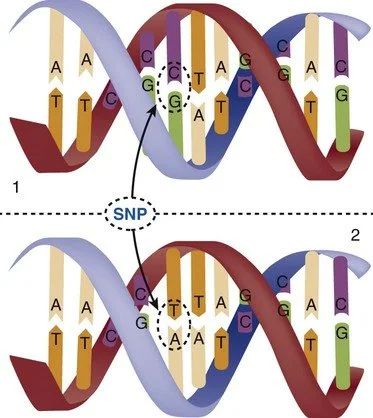
Image sourced from nursekey.com Genetics and Genomic in Critical Care
Vitamin C: A Case Study in Individual Variation
We've all been taught that Vitamin C is universally beneficial. For most people, it is. Ascorbic acid works as an antioxidant defense and regeneration aid, processed through enzymes including:
Catalase: Decomposes hydrogen peroxide, supporting ascorbic acid's antioxidant role
Glutathione peroxidase: Works with ascorbic acid to neutralize reactive oxygen species
Ascorbate oxidase: Catalyzes oxidation of ascorbic acid
Dehydroascorbate reductase: Regenerates ascorbic acid using glutathione
Most people make these enzymes just fine. Yet approximately 20% of European descendants only have partial function for Catalase production.
How Nutrients Move Through Your System
Our bodies are ecosystems within ecosystems—complex systems where each operates through specialized cellular structures. To understand how well your body processes nutrition, we look at how efficiently your SNPs help break down and recombine macro and micronutrients.
One key component is enzyme production capacity, determined by your SNP profile. Think of enzymes as tiny molecular tools—some act like scissors cutting proteins apart, others like keys unlocking biochemical reactions.

What this Looks Like in Practice
Iris Orsini, founder of Nirvana Living, discovered her body produces roughly 30% less catalase enzyme. Once she understood this limitation, she adjusted her approach:
No Vitamin C supplements as antioxidant boosts
No binges on high Vitamin C foods (bowls of cherries, guava drinks, whole raw bell peppers)
Pairing Vitamin C foods with Catalase-rich foods (white fish with sweet potato, parsley on avocado)
Choosing foods with both components (cantaloupe, banana)
Taking a catalase supplement when eating citrus
Before understanding this genetic reality, she would eat six oranges as a late-night snack in high school and wake up with severe brain fog. The SNP data finally explained decades of mysterious reactions.
The key insight: All nutrients are not ideal for everyone. Your genetic terrain determines what nourishes you and what creates burden.

Iris’s Journey With Functional Genomics
What I ingest these days is very different from what I used to eat. Many foods are no longer on the menu. Here are some of my SNPs, how they impact my health, and how I work with them:
Liver System Detoxification | Of the 22 key SNPs, one is non-functioning, four have limited function.
I avoid grapefruit (bergamottin blocks my detox pathways)
I limit aromatic amines, caffeine, charred/grilled meats, hair dyes, smoked fish
Liver System Methylation | Of the 14 key SNPs, three are non-functioning, five have limited function.
I avoid folic acid in fortified grains, cruciferous vegetables, dark legumes, alliums, high-quercetin pigmented foods, black/green teas (catechins), all alcohol
Cognition System | Requires careful management
No added sugar
Limited Vitamin C intake
Do I miss certain foods?
Absolutely—especially when I smell pizza. Yet I have no regrets.
It's transformative to no longer have headaches, sore joints, muscle pain, brain fog, anal fissures, breast cysts, scalp sores, extreme anxiety. All healed. My brain works better than ever: improved working memory, no longer dyslexic, much stronger emotional resilience. I now know how to support my physical body for pain-free living—which in turn supports my emotional and mental capacity.
Were these genetic insights the only route to my healing? No, of course not. But they were a crucial foundation—the bedrock that allowed everything else to take root.
The Analysis Journey
Understanding your genetic terrain is a process, not a single event. Here's the path:
Obtain Genetics

Investigate Vulnerabilities

Detail Boundaries

Organize Protocols
Reminder: This Content is Strictly Educational Information, not medical advice.
Terms of Use
Obtain Your Genetic Data
Select a testing service, receive your genomic health data, download your raw database file, resave as .CSV format
Considerations:
Multiple services available at varying price points
Some services provide more comprehensive data than others
Avoid certain providers with questionable practices (e.g., Dante Labs)
Investigate Your Vulnerabilities
Work with a professional to analyze your data, identify deficient and weak SNPs, group them by key functions (detox, methylation, etc.)
What you're mapping: The specific areas where your genetic terrain needs extra support
Detail Your Chemical & Nutritional Boundaries
What happens:
Compile substances to limit based on weak SNPs
Identify nutrients and supplements that support your weak SNPs
Analyze foods to create lists of what to avoid, limit, or increase
Cross-reference with additional test data (IgG/IgE, micronutrient deficiencies, food sensitivities)
What you're creating: Your personal guidebook for what nourishes vs. burdens your specific system
Organize Your Nutritional & Supplement Needs
What happens:
Set up a supplement tracking system
Create batches of AM and PM supplement packets
Design 30 meals using non-enriched, unprocessed, organic fats, proteins, plants, and fungi
Clear pantry contents that conflict with your SNP profile
Shop for ingredients aligned with your genetic terrain
What you're building: Daily rhythms and routines that support your body's actual needs.
Your Genetic Foundation
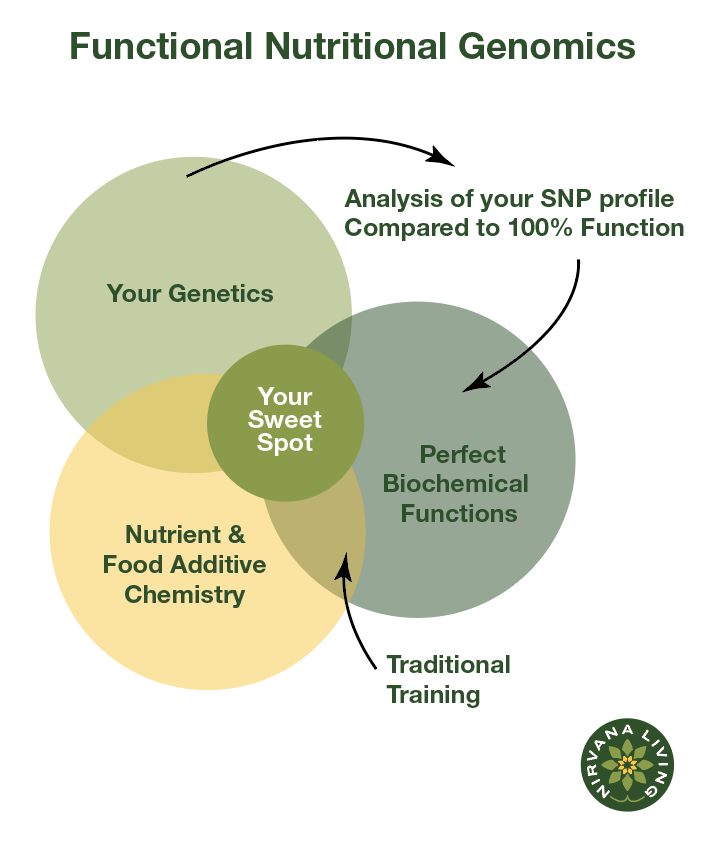
Functional Genomics bridges genomics, biochemistry, and nutrition science. It studies the intersection of your DNA, your body's ideal biochemical reactions, and the nutrients that support them—revealing how your SNP variations affect digestion, detoxification, and nutrient usage.
This field has matured over the past decade from rare disease screening to comprehensive root cause investigation. By analyzing your inherited genetic variants, you can identify the origins of chronic inflammation, allergies, metabolic imbalance, and even mental health challenges.
Understanding these functional details enables truly personalized nutrition—dietary adjustments designed to strengthen weak systems and optimize function. You're not working from generic advice anymore. You're cultivating the specific terrain you were given.
Our friends and family deserve our vitality. We deserve our vitality. That begins with knowing how to respect our roots.
Work With Your Health Practitioner
Taking care of the organs in your body that make your peptides is guided by diagnostic measuring.
Testing Lists
Know Your Peptides Dimmer SNPs.
Specific aging ones related are noted in green.
Adipose Tissue – Adiponectin
ADIPOQ Gene:
rs2241766 (+45T/G, exon 2) — G allele associated with lower adiponectin levels
GG genotype: 2.53× higher metabolic syndrome risk
Affects mRNA stability/splicing
rs1501299 (+276G/T, intron 2) — T allele associated with reduced adiponectin
Associated with hyperglycemia, metabolic syndrome
GG+TG: 1.42× metabolic syndrome risk
rs266729 (−11377C/G, promoter) — reduces ADIPOQ transcription
rs17366743, rs10937273, rs17300539, rs182052 — all associated with reduced adiponectin production in T2D
rs822396, rs17846866, rs3774261, rs822393 — multiple SNPs linked to adiponectin deficiency across diabetes types
Anterior Pituitary
GH1 (Growth Hormone Gene):
rs7208736 — minor allele associated with lower fasting GH (p = 5.15×10⁻⁶)
Associated with lower BMI and waist circumference in males
GHR (Growth Hormone Receptor Gene):
rs13153388 — elevated GH levels but reduced height (suggests GHR insensitivity; compensatory GH elevation)
rs17574650 (intron 1) — rare variant (MAF <3%)
rs6180 (exon 10) — associated with idiopathic short stature
GT-repeat microsatellite in 5′UTR — L/S genotype 3.3× higher risk of short stature in children
M/S genotype — 1.9× more frequent in male short stature
Brain/Central Nervous System – Endorphins & Enkephalins
PENK (Proenkephalin), POMC (Pro-opiomelanocortin) genes:
OPRM1 (Opioid Receptor Mu-1) SNPs affect receptor sensitivity, indirectly affecting endorphin feedback loops
rs1799971 (OPRM1 A118G) — affects opioid signaling & pain perception (not direct production, but functional impact)
Kidneys – Erythropoietin
EPOR (EPO Receptor) variants:
Direct EPO production SNPs are rare in the literature
Kidney function decline → reduced EPO production (age/disease-related, not genetic SNPs primarily)
Liver
IGF1 Gene SNPs (Promoter & Coding):
rs35767 — TT & CT+TT genotypes correlated with elevated osteoporosis risk (OR 1.90 & 1.35)
Indicates reduced IGF-1 function/production
2.11× increased risk in smokers/drinkers
rs2288377 — associated with lower IGF-1 levels in bone mineral density studies
rs5742612 — contributes to reduced bone formation phenotype
rs2162679 (IGF1) — AA genotype 2.2× higher myopia risk, suggesting altered growth signaling
rs1019731, rs12821878 — associated with breast cancer (IGF-1 pathway dysregulation)
Rare variants identified in centenarians:
A118T variant — located at E-peptide cleavage site; affects mature IGF-1 release
Pancreatic Beta Cells
INS Gene:
rs689 (−23/Hph1 A>T) — strongest non-HLA association with Type 1 Diabetes
Associated with short class I VNTR alleles
Reduced insulin production (autoimmune destruction)
OR = 1.81, p = 2.34×10⁻⁴⁵ in multi-ancestry GWAS
An allele associated with reduced INS gene expression in pancreas
VNTR class I alleles (rs689-tagged) — decreased INS expression relative to class III
Small Intestine – Enteroendocrine L-cells
GLP1R (GLP-1 Receptor — affects endogenous GLP-1 axis feedback):
rs6923761 (Gly168Ser, G>A) — minor A allele frequency 29% in Europeans
Alters GLP-1R function; affects glucose-dependent insulin secretion
Associated with delayed gastric emptying response to GLP-1 agonists
rs761387 — modifies oral semaglutide response
rs2268640 — suggestive genome-wide significance for GLP-1 response
rs10305420 (Pro7Leu C>T) — potentially alters GLP-1R response
rs10305510 (R421P)
rs140642887 (A239T)
rs149578908 (R310Q)
rs182447758 (R227H)
rs202171972 (D344E)
rs2235868 (R176G)
Parathyroid & Thyroid – PTH & Calcitonin
Limited SNP data, but relevant variants:
CASR (Calcium-Sensing Receptor) variants — affect PTH secretion sensitivity
VDR (Vitamin D Receptor) SNPs — regulate PTH/calcium axis indirectly
Thymus Gland – Thymosin
Limited direct genetic studies; immunosenescence-related:
Thymus involution is age-dependent, not SNP-driven primarily
However, IL-7 receptor SNPs and T-cell development genes (IKZF1, GATA3) may indirectly affect thymosin-mediated T-cell maturation