
Cancer Research
Restrictions on Substances
Our current level of freedom for cancer treatments in the USA follows the 2018 federal rule for Phase 1 FDA investigational drug trials. Existing FDA-approved drugs follows the physician latitude to use in an off-label manner.
Ivermectin
Is widely available without prescription across Latin America, Sub-Saharan Africa, and South Asia, with restrictions across nearly all of North America, the EU, Australia.
New Jersey operates under the 2018 rule. Florida has a Medical Freedom Act since 2026 that authorizes ivermectin as a behind-the-counter medication pharmacists can dispense to adults 18+ without a prescription.
As of July 2026: Tennessee, Arkansas, Idaho, Iowa, Louisiana have OTC/behind-counter ivermectin laws.
Mebendozole
FDA approved for human use for treating intestinal parasitic infections.
Fenbendazole
Over-the counter (OTC) for veterinary use.
Vitamin C
High-dose IV of Vitamin C as an adjunct to treatments.
Anktiva Immune Activating Therapy
A universal cancer treatment with approved in the USA for BCG-unresponsive bladder cancer. Approved for lung cancer in Saudi Arabia. Trials indicate promise for breast, pancreatic, and glioblastoma. https://anktiva.com/hcp
CAR-T Cell Immune Therapy
Approved for blood cancers. A biological re-engineering of a patient’s immune cells. Indicates promise for glioblastoma. Lymphoma Data
Keytruda (pembrolizumab) Immunotherapy
FDA-approved for more than 20 cancer types.
Important Note: This information is strictly educational and designed to help you become an active participant in your wellness journey. It is not intended to replace professional medical care. Always consult with your healthcare provider before making changes to your health regimen.

Cellular Mechanisms
Ivermectin
In vitro cultured cancer cell data. Considered pre-clinical in the USA.
14 distinct anti-cancer mechanisms summarized by Yuwen et al, encompassing inhibition of oncogenic signaling (YAP1, Wnt–TCF, Akt/mTOR, EGFR/NF-κB, MAPK), mitochondrial and oxidative-stress induction, ion-channel modulation, and suppression of both cancer stem cells and the epithelial–mesenchymal transition (EMT).
Wnt/β-catenin pathway inhibition
This pathway drives uncontrolled proliferation and self-renewal of cancer stem-like cells.
PI3K/Akt/mTOR modulation
Suppresses signaling that keeps tumor cells dividing and resistant to apoptosis.
PAK1 blockade
Inhibits PAK1 signaling for cancer cell motility, invasion, and limits metastatic spread.
Mitochondrial dysfunction → apoptosis induction
Triggers programmed cell death by disrupting mitochondrial membrane function in cancer cells.
Chloride channel-adjacent activity
Binding glutamate-gated chloride channels to increase it’s cytotoxicity.
Tumor microenvironment / immune conversion
Published Data
A 2021 Nature paper showed conversion of immunologically "cold" tumors (poor T-cell infiltration, poor immunotherapy response) into "hot" tumors by enhancing T-cell infiltration.
Draganov, D., Han, Z., Rana, A., Bennett, N., Irvine, D.J., Lee, P.P. "Ivermectin converts cold tumors to hot and synergizes with immune checkpoint blockade for treatment of breast cancer." npj Breast Cancer 7, 22 (2021).
Journal version (Nature.com): https://www.nature.com/articles/s41523-021-00229-5
Free full text (PubMed Central): https://pmc.ncbi.nlm.nih.gov/articles/PMC7925581/
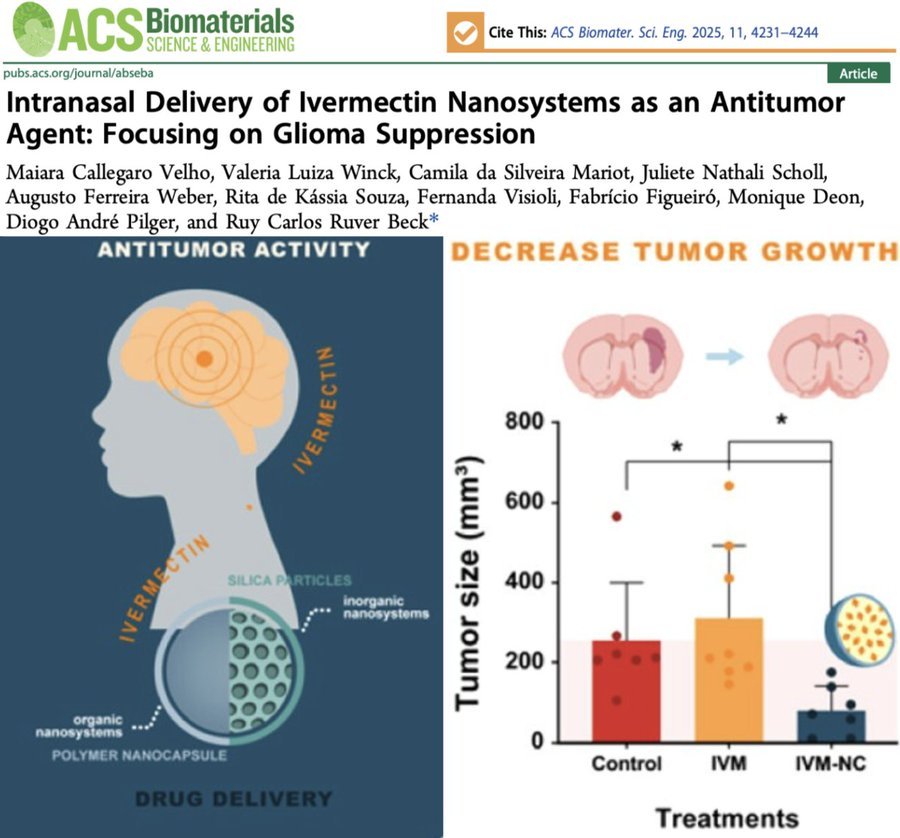
A 2025 preclinical study shows intranasal ivermectin nanocapsules safely shrink glioblastoma in animal models at doses lower than the approved human antiparasitic doses.
Rats with implanted glioblastoma tumors received intranasal nano-ivermectin for 10 days at 60 µg/day. Tumor volume dropped by ≈70% compared to untreated controls. The treatment also reduced necrosis, edema, and vascular proliferation, indicating less invasive and aggressive tumors. No toxicity was observed — normal liver, kidney, blood, and lung histology; body weight unchanged throughout treatment.
Cellular Mechanisms
Fenbendazole
Suspected mechanism is microtubule disruption via beta-tubulin binding (similar to some chemotherapy agents).
"Fenbendazole as an Anticancer Agent? A Case Series of Self-Administration in Three Patients" Author: Dr. William Makis et al., Journal: Case Reports in Oncology
Available via PubMed Central: https://pmc.ncbi.nlm.nih.gov/articles/PMC12215191/
The three self-administered cases with follow up of 1-3 years.
An 83-year-old woman with widely metastatic ER/PR-positive, HER2-negative breast cancer (liver, lungs, spine) — circulating tumor DNA dropped from 123 to 0 in under two months; imaging confirmed complete remission (NED); recurrence-free 11 months later at time of report.
Prostate cancer case — outcome described as complete or near-complete remission.
Melanoma case — imaging and blood tests at February 2024 follow-up showed NED; recurrence-free over 11 months at time of report.
Ivermectin Dosage Calculations
Step 1. Translate your weight in lbs to kg (divide by 2.2046)
100 lbs → 45.4 kg
125 lbs → 56.7 kg
150 lbs → 68.0 kg
175 lbs → 79.4 kg
200 lbs → 90.7 kg
250 lbs → 113.4 kg
Step 2. Select the dosage and frequency and consider if it will be a ramp up to particular daily level
For example: My mom was 150 lbs = 68 kg at her colon cancer diagnosis. Prior to surgery she began an anti-viral level dose to better resist hospital born infections. We sourced 6 mg tablets.
0.5 mg / 68 kg = 34 mg / 6 mg tablets = 5-6 tablets/day
Following surgery and before her first oncology appointment the dosage was increased to 10 tablets/day.
This dosage was maintained through three Kaytruda immunotherapies. At 6 months a cancer free status allowed for a reduction down to 3 tablets/day.
Step 3. Source and order a 3-6 month amount to allow for complete coverage between cancer cell checks.
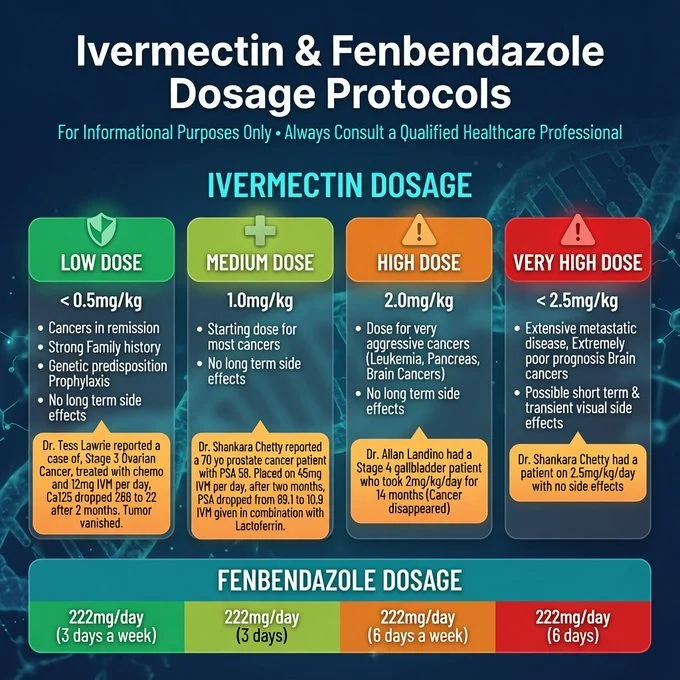
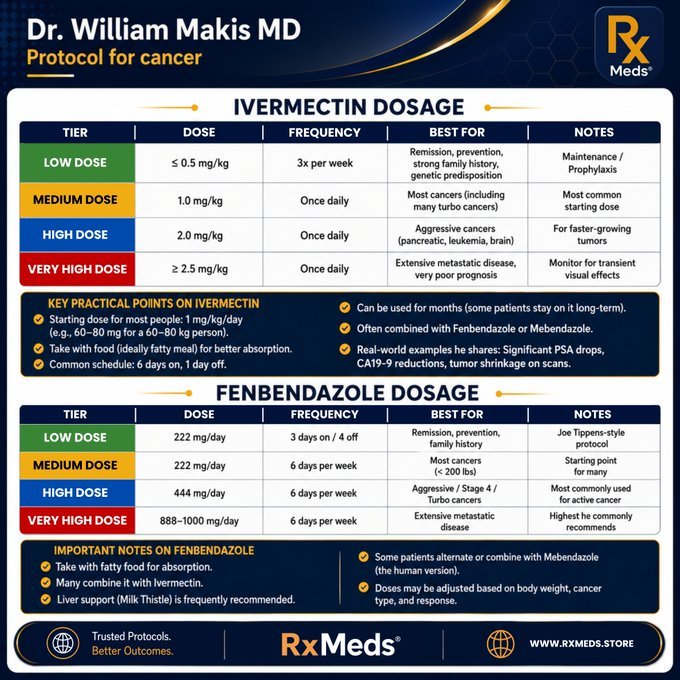
Dosage Charts
Cancer Researchers
William Makis in Florida makisw.substack.com
Research of repurposed drugs in cancer: Ivermectin, Mebendazole, Fenbendazole.
Patrick Soon-Shiong in California with Anktiva
Cancer Types
By organs
When Symptoms Appear
Tracking your infections.


Understanding Immune Boosters
If we have learned anything from our Functional Genomics Module it’s that immune boosters aren't one-size-fits-all. They're most effective when personalized based on your genomic profile, micronutrient test results, and current health burdens.
Targeted Vitamin & Mineral Supplementation
Your micronutrient test results should guide your supplementation strategy. While whole food sources are ideal when possible, supplementation often fills gaps that diet alone cannot address. Focus on correcting any identified deficiencies (while respecting your SNPs) which commonly include:
Vitamin D3 – Essential for immune cell activation and regulation
Zinc – Critical for immune cell development and anti-inflammatory responses
Vitamin A – Supports mucosal barrier integrity and immune cell differentiation
Vitamin C – Powerful antioxidant that supports various immune functions (unless contraindicated by your genetics)
B Vitamins – Especially B6, B9 (folate), and B12 for immune cell production and methylation support
Selenium – Important for antioxidant defense and immune regulation
Magnesium – Supports hundreds of biochemical reactions, including immune function
For a comprehensive exploration of food sources for nutrition we plan to build a Nutrient Guide.
Advanced Immune Supporters
Alpha-Lipoic Acid, Bovine Colostrum & Immunoglobulins (IgG, IgA), BPC-157, CoQ10 (Ubiquinol), Glandulars, Lactoferrin, L-Carnitine, Liposomal Glutathione, NAC (N-Acetyl Cysteine), NAD+ Precursors, PQQ, Resveratrol, Thymosin Alpha-1, Wellmune Beta-glucan
Learn more here Immune Support Module

Case Study: How Mom reversed cancer in 6 months
To be completed.
Support Protocol
Glutathione - increased to twice per day
Ivermectin - 12mg, 3 times per day
Taurine
9 Essential Amino Acids